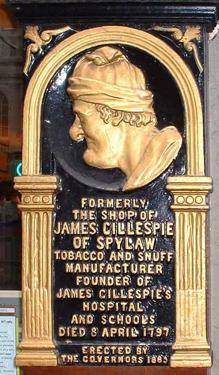
James Gillespie (1726 – 1797) was an Edinburgh snuff and tobacco merchant.
James Gillespie’s success in the snuff and tobacco industry, which he shared with his brother John, meant that in 1759 he was sufficiently wealthy to rent Spylaw House and its estate on the edge of Edinburgh. As Laird of Spylaw and one of Edinburgh’s richest men, Mr Gillespie was a well known figure in Edinburgh at the time of the Scottish Enlightenment.
In spite of his position of wealth and privilege, the bachelor Mr Gillespie led a thrifty and pragmatic life, shunning pretentiousness and ostentation and sitting down to eat with his servants each evening. “Waste not, want not” was his favourite saying.
Prior to his death in 1797 at the age of seventy one, he instructed that his estate be used to found a hospital for poor people and a school for poor boys.
The first James Gillespie’s School was opened in 1803 and sixty poor boys were enrolled to be taught by one schoolmaster. Over the years that followed the school went through a great many changes. By the mid twentieth century the school for poor boys had changed into James Gillespie’s High School for Girls and the author Muriel Spark is perhaps its most famous pupil.
In 1975 James Gillespie’s High School for Girls became a state comprehensive school run by the local council and at this time the primary department, which also took boys, separated from the High School and became James Gillespie’s Primary School. The building in which the school is currently housed was completed in 1991. There have been further extensions, annexes, playground redevelopments and a new nursery.
What Mr Gillespie would have thought of the school as it is today can only be imagined. Surely he would have been surprised to think that the school he founded so many years ago would endure to celebrate its two hundredth anniversary and move forward to the future as a well established and well loved school in this ancient city.
We acknowledge the connections James Gillespie had to the North Virginia slave-owning tobacco plantations. It is important for our children to understand the role our country and other countries played in slavery. Our school vision, values and aims mean that children learn about human rights and the importance of treating everyone with respect. We do not tolerate racism and have clear procedures for dealing with racism where it occurs.